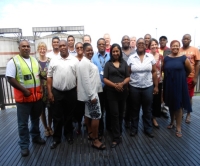
 SERV has been on a mission in the South-African Richards Bay and to Maputo in Mozambique from 15th to 21st of March. The mission took place in the framework of an international ILO-project sponsored by the Flemish and by the Dutch governments aiming at the strengthening of the social dialogue in the ports sector.
SERV and the Flemish Ports Commission together with Dutch and Flemish social partners from the ports sector are involved as technical partners and experts. The project itself is a follow up of a previous project in Durban, South-Africa.
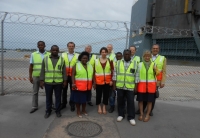 Participated in this mission: René De Brouwer of BTB-ABVV (trade union), Joost van der Lecq of FNV (trade union) en Guy Vankrunkelsven, delegate of the employers’ or-ganization CEPA- port of Antwerp. SERV was coordinating the mission.
 Recently each fiche in Competent has been linked to the international classification ISCO-08 (International Standard Classification of Occupations). Online databanks for occupations often use their own specific classifications or they are only available in one language. This is hindering the mutual exchange of data between the databanks that are operational in the different countries. As Competent is based on ROME-V3 the exchange of data with France was not posing any problems. The recent linkage to ISCO makes it from now on possible to exchange data on a European level and offers new and promising perspectives.
 An important and increasing group of Flemish men and women are struggling with mental or psychiatric problems. Often they stay ill at home (temporarily) or they are/get unemployed. Social partners and the Users’ Consultation Body on Disability in the Flemish Diversity Commission want to tackle this situation. They think this situation entails an important loss of valuable labour force potential. Moreover, getting back to work often plays an essential role in the recovery process. The Flemish Diversity Commission therefore is convinced that it is urgent to tackle the stigmatization of people with mental problems and to give them more financial security. Ultimately they want them to get (back) at work.
 In 2013 social partners were focusing on the 6th institutional reform in Belgium aside from their “business as usual?? advisory function. The newest institutional reform gives Flanders a unique opportunity to build and develop carefully planned and efficient policies on social protection, labour market, economy and energy. Dialogue within the SERV Commissions deepened and social partners were intensely involved in the further elaboration of previous proposals. The final output in the form of a new SERV-agreement can be expected in 2014.